- Short Description:
Chalcedony is a peculiar gemstone that makes it a fun and inviting family of gemstones that is carvable and durable.
- Long Description:
Chalcedony is a peculiar gemstone in that it is a mixture of two minerals: quartz and morganite. The result of this mixture is a fun and inviting family of gemstones that is hard and durable enough to stand up to everyday wear but soft enough to serve as a medium for carving.
Chalcedony is a peculiar gemstone in that it is a mixture of two minerals: quartz and morganite. The result of this mixture is a fun and inviting family of gemstones that is hard and durable enough to stand up to everyday wear but soft enough to serve as a medium for carving. The stone is typically tumbled rather than faceted, creating a vivid, translucent orb as enticing as a piece of candy. Varieties of chalcedony include agate (brown, orange, and red, like Jupiter), carnelian (toffee or honey-colored), chrysoprase (lime green), and onyx (black).
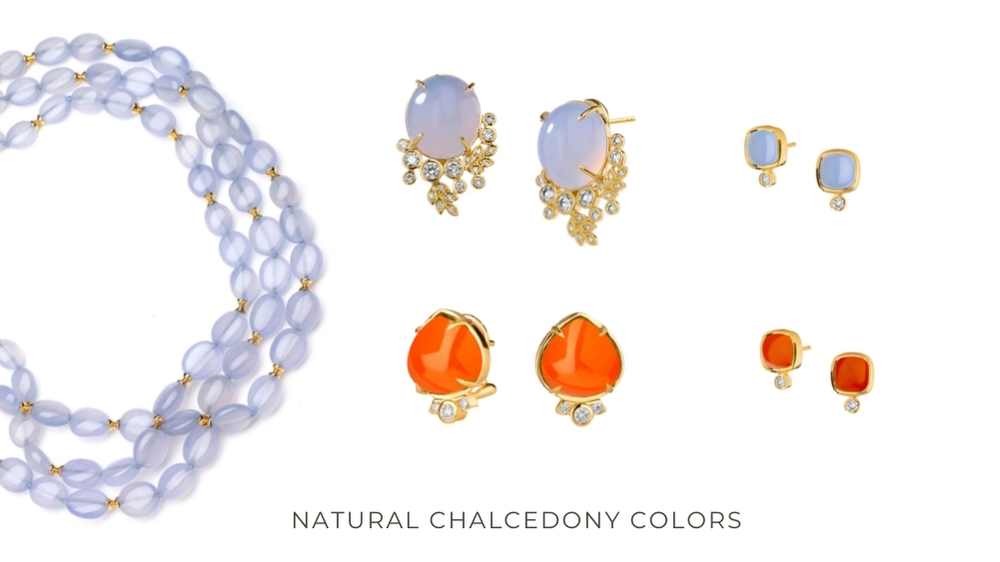
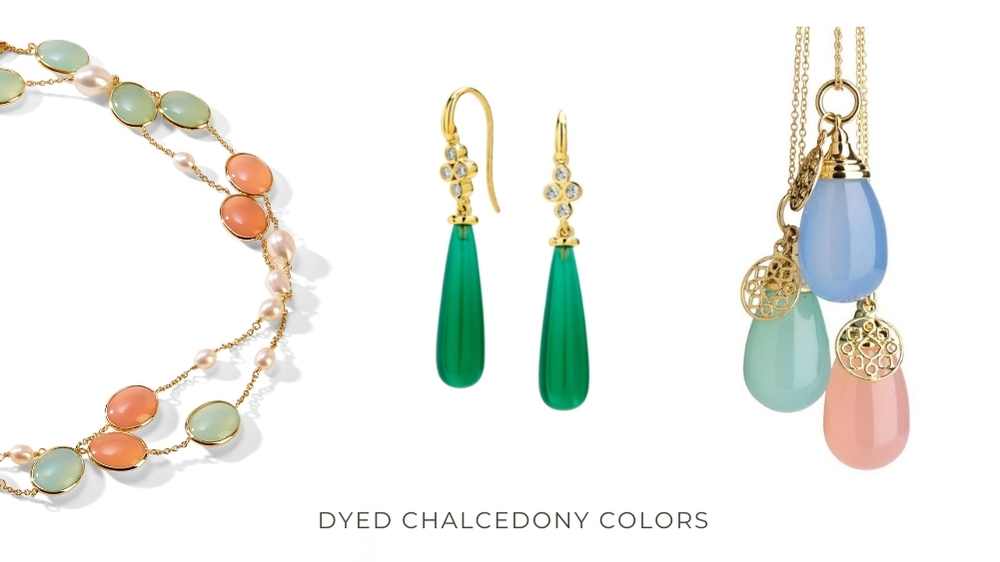
Chalcedony itself also appears in a dizzying array of colors. In its natural state, it is typically a pale bluish-gray. The blue and orange varieties, used in our Candy Sugarloaf Studs are natural; other colors, such as the emerald green in our Mogul Drop Earrings, or the blue-green and peachy-pink varieties, used in our Candy Chalcedony & Pearl Necklaces are the result of a dyeing process in which the stone is soaked in a solution. This process causes a permanent chemical change to the stone, and the dye does not run or fade. From its natural blue-gray and orange shades to the many vibrant, candy-colored shades of dyed chalcedony, there’s something for everyone. What’s your favorite flavor?
Fun, bright, and vibrant, yet also peaceful, mysterious, and ethereal, chalcedony intaglios (images carved into gemstones) were popular during the Victorian era. The translucent blue-gray of natural chalcedony imparted a dreamy vibe to the mythology and nature-inspired scenes often depicted in these rings and brooches.
Though carving was the main use for chalcedony throughout much of history, there is something special about a tumbled, polished chalcedony. It’s not quite like other gemstones. Its smooth, translucent surface has the ability to instill a sense of calm in the wearer. Popular among powerful Roman citizens, chalcedony was worn by none other than Roman orator Cicero, perhaps to keep him calm and focused while delivering a speech. The stone encourages reflection and meditation and helps those pursuing wisdom. It is the perfect accessory for anyone seeking the joy and ease that comes from a relaxed state of mind.
- Short Description:
A talisman of wisdom, beauty and longevity, many people in India have believed that Topaz worn above the heart assures long life, beauty and intelligence.
Topaz served as a symbol of strength among the Greeks. Europeans at the time of the Renaissance believed in its power to destroy curses and dispel anger. "Topaz" comes from the Sanskrit word "tapas" which means "fire". For centuries, many people in India have believed that topaz worn above the heart assures long life, beauty, and intelligence. In the past, a lot of people mistook any yellow-colored gemstones for topaz. "Imperial Topaz" named in honor of the Russian monarchy, is the distinct pinkish-orange hue discovered in the 19th century near the Ural Mountains in Russia.
COLOR
This gemstone features a variety of colors, from colorless, light blue, yellow, orange, pink, violet, brown, and very rarely, red. The element of chromium causes natural pink, red, and violet to purple colors in topaz. Imperfections at the atomic level in the topaz crystal structure can cause yellow, brown, and blue color. Colorless topaz is plentiful and often treated to gove it a blue color. The rarest, and hence most prized color, is a vivid purplish pink.
CLARITY
Faceted blue topaz is almost always free of eye-visible inclusions. Other more rare colors like orange and pink may show inclusions more often and still be valuable due to the color's rarity.
SOURCES
The largest topaz mines are in Brazil, Pakistan, Russia, and Sri Lanka.
Treatments
The vast majority of blue topaz seen today is the permanent result of changing the color by irradiation and heating. "Mystic Topaz" has an extraordinary rainbow effect and is made by coating colorless topaz with a thin artificial film placed on the surface by vapor deposition.
care
It is important to avoid steam or ultrasonic cleaners for topaz. Warm, soapy water works best.
- Short Description:
The beautiful blue-green color of Turquoise, the birthstone of December, will transport you somewhere warm in the depths of winter: to tropical seas with its blue-green color and oceanic patterns, or to the clear desert sky above the American Southwest or Persia in its sky-blue variety.
- Long Description:
The beautiful blue-green color of Turquoise, the birthstone of December, will transport you somewhere warm in the depths of winter: to tropical seas with its blue-green color and oceanic patterns, or to the clear desert sky above the American Southwest or Persia in its sky-blue variety.
The beautiful blue-green color of Turquoise, the birthstone of December, will transport you somewhere warm in the depths of winter: to tropical seas with its blue-green color and oceanic patterns, or to the clear desert sky above the American Southwest or Persia in its sky-blue variety. The name by which we know it today comes from the French, who called it pierre turquoise, as the first turquoise to reach Europe passed through Turkey, but its influence and historical and cultural significance range far wider than that.
History
While the Persians (located in modern-day Iran) have been mining turquoise for two thousand years, the gemstone has been in use for even longer. Turquoise has appeared in jewelry for longer than almost any other gemstone. The subtle bands of light blue that so beautifully complement the dark blue lapis lazuli and contrast the gold in Tutankhamun’s mask, dating back to the 1300s BCE, are turquoise. It was one of the first stones mined by humans, as it can be collected from the ground without a lot of manpower, sophisticated tools, or complex mining techniques. Even today, it is often mined by hand, just as it was thousands of years ago.
During the Mogul era, master artisans from all over Asia flocked to India. Persian artists brought their love of turquoise, integrating that unique shade of blue-green into the classic Mughal color palette of gold, jade, ruby, and sapphire. It’s one of the inspirations for some of our own pieces, such as the Seven Chakra Charm Bracelet and Mogul Kamala Turquoise Earrings.
In the United States, however, turquoise is most closely linked to Southwestern Native American cultures, such as the Pueblo, Zuni, Hopi, and Navajo. Turquoise is connected with elemental forces in many Southwestern creation myths. The Navajo say the first man and woman used a stone disk with a turquoise edge to create the sun, while for the Zuni, blue turquoise represents masculine energy and the sky and green turquoise represents feminine energy and the earth.
Color
If you remember your high school chemistry class, you might remember the time the teacher added copper to a flame and turned it green. Copper has the same effect on turquoise. Its presence in trace amounts gives the stone its distinctive color, ranging from blue-green to pale green.
In addition to copper, turquoise also contains iron. Both copper and iron are prone to oxidation: it’s why metal objects form rust and the copper Statue of Liberty has turned green. Over the course of decades, your turquoise may slowly change color due to oxidation, with complex patterns of green, brown, and yellow forming on the surface. This is a natural phenomenon that many turquoise lovers find beautiful.
Cleaning and Care
Turquoise was born in the desert and prefers that kind of arid climate, but it can thrive anywhere with a little care. Due to its porous surface and the presence of copper and iron, exposure to oils (including skin oils), humidity, and moisture can accelerate this color change or damage the stone. When you’re not wearing it (which might not be often, because you’ll never want to take it off!), store turquoise jewelry in a dry and dark place, preferably in a sealable plastic bag inside of a box. Take care to wipe down your turquoise with warm soapy water after use.
- Short Description:
One of the major jewelry trends to look out for in 2023 is simplicity. Elegant, understated jewelry is always in style, but next year will see more people embracing simple sophistication. We’ve been fans of colorless gemstones for a long time. They embody the ethos of understatement with their stark beauty and hidden, subtle complexities. So if you’re looking for colorless gemstones, look no further than diamond, moon quartz, and rock crystal, three striking, and strikingly different, ways to capture that quietly elegant style.
- Long Description:
One of the major jewelry trends to look out for in 2023 is simplicity. Elegant, understated jewelry is always in style, but next year will see more people embracing simple sophistication. We’ve been fans of colorless gemstones for a long time. They embody the ethos of understatement with their stark beauty and hidden, subtle complexities. So if you’re looking for colorless gemstones, look no further than diamond, moon quartz, and rock crystal, three striking, and strikingly different, ways to capture that quietly elegant style.
One of the major jewelry trends to look out for in 2023 is simplicity. Elegant, understated jewelry is always in style, but next year will see more people embracing simple sophistication. We’ve been fans of colorless gemstones for a long time. They embody the ethos of understatement with their stark beauty and hidden, subtle complexities. So if you’re looking for colorless gemstones, look no further than diamond, moon quartz, and rock crystal, three striking, and strikingly different, ways to capture that quietly elegant style.
Diamond
A true classic that embodies simple sophistication. Diamonds are versatile stones, and how they make you feel is all in the presentation. They can be over-the-top and conspicuously luxurious, calling attention to themselves and the wearer, or they can be more low-key. Many of our pieces that embody this low-key luxury use small diamonds as accent stones, drawing the eye to the large central gemstone rather than taking attention to themselves.
Moon Quartz
Take one look at any of our moon quartz jewelry and you see where the name comes from. This gem, presented as a polished cabochon rather than cut and faceted, glows with the same mystical, mysterious energy as the moon. There’s something calming about this stone that lends itself to sleek, understated designs. Moon quartz works wonderfully with an understated design to create an intriguing, alluring elegance perfect for formal and casual occasions: just check out this bracelet from our Candy collection, for example.
Rock Crystal
The purest variety of quartz, rock crystal gives you a lot of sparkle for the price. Being more common and less expensive than diamonds, a single large rock crystal can make a big statement. They can be cut in all kinds of imaginative ways, adding some whimsy to their cool, icy shine. These Hex Studs are a good example of the bold yet simple statement a dazzlingly cut rock crystal can make.
These gems contrast beautifully with gold, together making a simple, elegant statement, whether alone or accented by smaller stones. Colorless or white stones are a timeless look that works with just about any outfit and any occasion. Which one is your favorite?

