Short Description: Citrine is a variety of quartz, and quartz has been used in jewelry for thousands of years. The name citrine comes from the French "citron" and Latin "citrus" meaning lemon-colored. It is believed to carry healing properties of the sun, with restorative powers for the body and soul.
The name citrine comes from the French "citron" and Latin "citrus" meaning lemon-colored. Citrine is a variety of quartz, and quartz has been used in jewelry for thousands of years. Naturally colored citrine is rare, and today most citrine quartz is the result of heat treatment of amethyst quartz. Even so, gems from the Victorian era have surfaced, demonstrating that citrine was treasured even in earlier times.
cOLOR
Citrine is the transparent, pale yellow to brownish orange variety of quartz and is quite rare in nature. In the days before modern gemology, its tawny color caused it to be confused with topaz. In the contemporary market, citrine's most popular shade is an earthy deep brownish or reddish orange. The finest citrine color is a saturated yellow to reddish orange free of brownish tints.
CLARITY
Ey-visible inclusions are not common in citrine but if present they decrease its value.
Sources
The top sources of natural citrine are Bolivia, Spain, Madagascar, Mexico, and Uruguay. Amethyst which is heat treated to a citrine color is mostly mined in Brazil. In Bolivia, amethyst and citrine colors can occur together in the same crystal. These unique gems are called ametrine.
TREATMENTS
Most citrine is the result of heating, which converts less valuable shades of purple amethyst to golden shades of citrine. The saturation of the original hue will determine the richness of the resulting citrine yellow. Citrine's attractive color, plus the durability and affordability it shares with most other quartz, make it a top-selling yellow to orange gem.
CARE AND CLEANING
Citrine can be safely cleaned with warm, soapy water. Ultrasonic cleaners are usually safe except in the rare instances where a stone is dyed or treated by fracture filling.
Short Description: The union of art and craft—imagination and application—is something that has always been important to us. Our jewelry has to look as fresh in ten or fifty years as it does today.
Long Description: The union of art and craft—imagination and application—is something that has always been important to us. We never want to follow trends, as trends are fleeting and will ultimately make your art quickly seem dated or anonymous. Our jewelry has to look as fresh in ten or fifty years as it does today.
The union of art and craft—imagination and application—is something that has always been important to us. We never want to follow trends, as trends are fleeting and will ultimately make your art quickly seem dated or anonymous. Our jewelry has to look as fresh in ten or fifty years as it does today. What might look great now could look cheap or cliché in the very near future. So rather than just make jewelry, we aim to craft works of art that will stand the test of time, and that will remain a part of your life as trends change, styles evolve, and your life experience leads you to see the world in new ways.
In this way, we’re creating heirlooms for you and your family. But for a piece of jewelry to become an heirloom, you first have to love how it looks. It has to resonate with you in some way. We believe that as long as our designs come from the heart, they will find a place in yours.
To do this, we approach jewelry design as an art and a craft. It’s one thing to have a great idea, but you also need the craft to execute it. Art is the transformation of experience into an object, whether a painting, a poem, a film—or a piece of jewelry. It comes from being present in every moment, opening yourself to receive inspiration, and finding meaning in even the smallest things. We are always looking for little sources of joy in life, and we transform that joy into something we can share with you through our jewelry.
Craft is the work that goes into that transformation: the skills, the tools, the application of knowledge, and training. Our jewelers are always learning. No matter how good you are, there’s always something more to learn! When you’re first starting out, the amount of things you need to learn in any field is overwhelming. When you get a little experience under your belt, you might start to feel like you know everything. But true masters of a craft know that despite all of their knowledge and experience, they know only a fraction of what’s out there, and they never stop studying and learning from every situation. That’s what it takes to craft a jewel that looks great now, can be worn for any occasion and will be cherished by future generations.
Our jewelry is crafted for everyday wear, to be a part of your life. But it’s also crafted to last a lifetime—many lifetimes, we hope, as that special piece is handed down from generation to generation, with all of your family’s memories intact.
Short Description: Anyone with a profound wanderlust can find inspiration in the swallow which are innately social birds that seem to radiate peace and happiness.
You may have noticed how often the swallow features in our jewelry. It’s not just because they’re beautiful creatures with striking, elegant silhouettes. We are in love with the spirit that these little birds embody. And we’re not alone: the swallow has been immortalized in art and myth throughout human history. From the Arctic tundra to the tip of Patagonia, wherever there are people, there are swallows. And many of those people, past and present, have watched their distinctive shapes dart across the sky every spring, gathering for their annual migration, wondering where exactly it is they go and how they always find their way back.
The swallow’s migration is an incredible journey. Departing from Northern Europe, they cross the Mediterranean, fly over the Sahara, and don’t stop until they reach South Africa, traveling literally halfway around the world. And the amazing thing is, they always come back to the exact place they left. They have a desire to explore the world, but they know where home is: perhaps that is why they symbolize loyalty in China and Japan.
These birds love to chat, too. They’re constantly chirping with one another, and they are rarely seen fighting. There is a lesson about open communication and peaceful relationships that we can learn from them!
Wanderlust
Anyone with a profound wanderlust can find inspiration in the swallow. These are innately social birds that seem to radiate peace and happiness, yet they have a strong spirit of independence. They are hardworking world travelers, full of energy. And though they can’t be tied to one place, you can rest assured that they will always come home.
Around the world, swallows symbolize the beginning of spring, bringing with them sunshine, warmth, and new life. They inspire us to live an authentic life in which we value both independence and community. The swallow knows that this is the source of a happy, peaceful life of fulfillment.
Short Description: Though it is native to the Indian subcontinent, the majestic peacock has been capturing the imagination of people around the world for millennia. It has certainly captured ours!
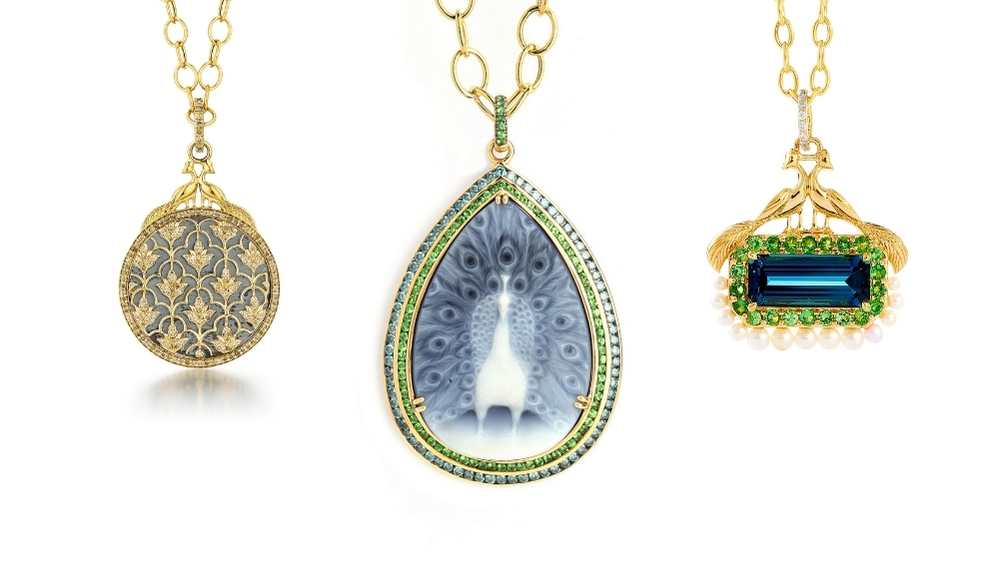
Long Description: Though it is native to the Indian subcontinent, the majestic peacock has been capturing the imagination of people around the world for millennia. It has certainly captured ours! Today, they are seen as proud creatures who love showing off their beautiful plumage in extravagant mating displays, but there is far more to the peacock, national bird of India, than simply showing off.
Though it is native to the Indian subcontinent, the majestic peacock has been capturing the imagination of people around the world for millennia. It has certainly captured ours! Today, they are seen as proud creatures who love showing off their beautiful plumage in extravagant mating displays, but there is far more to the peacock, the national bird of India than simply showing off.
So much of our inspiration comes from an appreciation of form and pattern in both the natural world and the manmade environment. The peacock has been an inspiration for artists since ancient times, and we are no different. We’re just as captivated by this creature as the artisans who carved its curving features into temple walls, the artists who painted them in impossibly vibrant blues and greens, or the poets who saw in them a symbol of love. The wonder of the peacock soon spread around the world. King Solomon brought peacocks to his garden in Jerusalem, Alexander the Great introduced them to Greece, and Roman statesman Pliny the Elder wrote about their singular beauty.
When you see him walking with his flock, the peacock already stands out with its long train of feathers, bright blue neck, and crown tipped with little blue drops like sapphires. He graces farms and villages, even city streets, with his presence, as though he knows but doesn’t care that all eyes are on him.
But then he shimmies, and from his back unfurls a fan of feathers: from what looks like a cluster of gold coins emerges a golden net of gilded thread adorned with eyes of green and blue gemstones. In our peacock-inspired designs, we’ve chosen tsavorite, blue topaz, and blue diamonds to capture these hues, which are unlike anything else in the animal kingdom. In nature, this kind of beauty is typically reserved for the males of the species, but why should they have all the fun?
When the peacock reveals its bejeweled plumage, it’s like he’s let you in on some cosmic secret that cannot be put into words. The ritual is intended to attract a mate, but sometimes, a peacock will dance alone, as though for its own pleasure. It’s more than just beautiful. The peacock isn’t showing off; the performance is for him alone. Perhaps that’s why the peacock represents wisdom in some Buddhist traditions.
Peacocks don’t keep this beauty year-round. The molting season begins in December when peacocks scatter their feathers like gemstones in a riverbed. These feathers are said to bring good luck and prosperity to those who hold onto them.
The Mogul emperors sat on a throne adorned with dancing peacocks and studded with hundreds of precious gemstones. Extravagant yet elegant, indulgent yet refined, and delicately powerful, the throne not only embodied the beauty of the peacock but the essence we hope to capture in our peacock-themed pieces.
Short Description: Our thoughts, emotions, and spirituality all combine to give us our identity. Influenced by our environment, the three aspects of ourselves combine to make us who we are.
The connection between mind, body, and spirit is an incredible thing. A broken leg, for instance, doesn’t just cause you pain and keep you off your feet for a few weeks. It can make you pretty depressed, sitting there in bed, looking out the window, wishing you were out there walking around. Likewise, emotional stress can cause the body to attack itself, making you physically feel the symptoms of an illness. Isn’t it strange how that works? Mind, body, and spirit: they are not three distinct systems that have to be taken care of individually. What affects one affects the others.
Our Identity
Our thoughts, emotions, and spirituality all combine to give us our identity. Influenced by our environment, the three aspects of ourselves combine to make us who we are. A person in emotional distress, without support, is going to have a harder time healing an injury to the body. Someone in spiritual turmoil will experience negative emotions that will seep out into their interactions with others. When everything is in harmony, life is like a spinning wheel with no beginning or end. But when something is amiss, that circle becomes a spiral.
Like the two ends of a line coming together to form a circle, everything is connected: the physical, the emotional, and the spiritual. The concept of the chakra allows us to visualize this. The word “chakra” comes from the Sanskrit word for “wheel” or “circle,” and it describes one of the seven energy centers in the body. When we look at health through the lens of the chakra, we take into account not only physiological problems but psychological and spiritual issues, as well, as the three are all connected. It is well-documented that some physical ailments have psychological causes. This doesn’t mean that it’s “all in your head” or the illness is fake. It is simply your body telling you that something is wrong—something is blocked. And on the other hand, an ongoing physical ailment can put you into an emotional state that makes healing impossible. It’s all connected; it’s all part of that wheel. Thinking in terms of chakras allows us to approach our lives holistically.
Seven Chakras, Seven Colors
Each of the seven chakras is associated with a color of the rainbow: seven chakras, seven colors. That’s why the pieces of our Chakra collection feature a suite of sapphires ranging from pink to purple. That’s right, sapphires aren’t only blue. They are a variety of mineral corundum and appear naturally in all of the colors of the rainbow. They are also a hard stone, perfect for everyday wear, and can bestow peace and clarity upon the wearer, perfect for someone looking for the spiritual strength to see themselves, the world, and their place in that holistic manner.
The symbol of the wheel gives us one tool to see everything as part of one thing. Associating each chakra with color gives us another useful metaphor: the color wheel. Where does the color wheel begin? What is the “first” color? If we think in terms of wavelength, of course, we can say that the spectrum of visible light goes from long-wavelength red to short-wavelength violet (or vice versa), but when we look at colors on a wheel, there is no beginning or end, only one unending continuum of color, only relationships between colors: complementary (colors opposite each other), analogous (colors next to each other). Relationships between colors can be balanced and harmonious, or they can clash.
Life in Balance
The circle, and the colors of the rainbow, they are reminders of the cyclical nature of the universe and the interconnectedness of all things. Healing occurs when the mind, body, and spirit are in harmony. When we are balanced in our chakras, our energy is in alignment. Let the pieces of the Chakra collection be your talismans empowering you to care for yourself—your whole self—in simple ways, every day, whether it’s remembering to take a break and go outside, to stay hydrated, to schedule that physical, to put down the phone and go to bed a few minutes earlier. In short, let them be your reminder to live a life of balance.