Complimentary Shipping & Fuss-Free Returns

Listen To Your Internal Compass

  • Short Description: No one in the world can tell us what makes sense to us; we have to discover that ourselves. Listen to your internal compass and let it guide you.

Carl Jung said, "The pendulum of the mind alternates between sense and nonsense, not between right and wrong." Human beings have an internal compass that helps them navigate between what makes sense and what doesn't. No one in the world can tell us what makes sense to us; we have to discover that ourselves. Other people can advise us, but they cannot make the decision for us.

When we find the courage to do what makes the most sense to us, we will find opportunities at places where we did not even look in the first place. New worlds will open up. New opportunities will unfold as a result of following one's inner compass. 

Listen to your internal compass and let it guide you. You will find that the more you listen to that inner voice, the more you will be open to opportunities that come your way. 

Reflections

  • Hits: 2098

Always Something New at Syna

  • Short Description: When it comes to creativity, we’re all about experimentation, exploration, and transformation. That means we’re always open to inspiration from anywhere, which you can see in the inspirations for our various collections.

When it comes to creativity, we’re all about experimentation, exploration, and transformation. That means we’re always open to inspiration from anywhere, which you can see in the inspirations for our various collections. And if you’re always looking for inspiration, always exploring the world around you, and always looking for new ways of working, you’re always going to come up with something new.

What is New?

What does it mean to be “new”? Hasn’t everything been done already? Maybe it has, but don’t let that discourage you: it hasn’t been done by you. You are what makes it new. Whatever you do, if you do it honestly and passionately (and not just because someone else is doing it or because it is profitable), will be original because it will carry a piece of you. That piece of you will connect with someone else. And that connection will be something that has never happened before.

But not every new idea works. Not every spark of inspiration starts a fire, and not every concept results in a new piece of jewelry. Again, we can’t let ourselves be discouraged by that fact. You could feel like you’re wasting your time, that you’ve failed, and that you’ll never create anything worthwhile. But if you’ve put your heart into it, and if you’ve grown from the experience, that time was not wasted. Failures are only failures if you fail to learn from them. When it finally clicks, and you produce something new and beautiful, something you’ve never done before, you see that all of that effort is a part of that final product, whether it is a new, original jewelry design or a recipe that you’ve modified, or a relationship.

Always More To Learn

When you’ve done something a few times, you start to feel like you have mastery over it. But if you want to keep it fresh, you can’t see yourself as the finished article, the all-knowing master of your craft. There’s always more to learn, and you can learn from novices and masters alike. So we’re always looking to evolve and grow, always flowing like a river. There’s a saying that you can never step into the same river twice: the water is always flowing, and that water you stepped into long ago has now emptied into the sea. Yet the river is still recognizable as a river, as a single, continuous thing. We are all like that river. We know who we are, and we have a sense of history and connection with others, but we are always changing and growing.

We will always keep that spirit of growth, open-mindedness, and adventure alive so that there will always be something new at Syna.

Reflections, About Us

  • Hits: 1763

Is My Diamond Fake? Eleven Tests You Can Try at Home

  • Short Description: Has this ever happened to you? You’ve come into a piece of diamond jewelry, but you’re not exactly sure if it is indeed a diamond. Maybe you inherited a family heirloom, or you purchased a diamond for a suspiciously low price, or someone gave you a gift. You start to wonder what it’s really worth. Is this the real thing? Is there any way to truly know?
  • Long Description: Has this ever happened to you? You’ve come into a piece of diamond jewelry, but you’re not exactly sure if it is indeed a diamond. Maybe you inherited a family heirloom, or you purchased a diamond for a suspiciously low price, or someone gave you a gift. You start to wonder what it’s really worth. Is this the real thing? Is there any way to truly know?

Has this ever happened to you? You’ve come into a piece of diamond jewelry, but you’re not exactly sure if it is indeed a diamond. Maybe you inherited a family heirloom or purchased a diamond for a suspiciously low price, or someone gave you a gift. You start to wonder what it’s really worth. Is this the real thing? Is there any way to truly know?

First of all, what do we mean by “real”? The word “diamond” describes a mineral crystal composed of at least 99.95% carbon. A real diamond can be grown in the upper mantle, the layer of the Earth below the crust, over the course of millions of years, or in a laboratory over a few weeks, either by a process called High Pressure, High Temperature (HPHT), which mimics the hot, pressurized environment in which natural diamonds grow, or Chemical Vapor Deposition (CVD), a process by which carbon atoms are added layer by layer to a diamond seed inside of a vapor-filled chamber.

The following methods will tell you whether or not your stone is a diamond, but many of them won’t tell you if that diamond came out of the ground or out of a laboratory. That’s a much more difficult distinction to make, requiring an expert gemologist to use technology that is not commercially available. But if you want to determine whether your diamond is a diamond and not glass or some diamond imitation like cubic zirconia or moissanite, here are a few simple tests you can try at home.

The Electronic Test

The simplest and most accurate way to determine the authenticity of your diamond is to purchase an electronic diamond tester. You can buy these on Amazon, and they are relatively inexpensive. These devices heat the diamond and measure the rate of thermal conductivity to determine whether or not the stone is a diamond.

Newspaper “Read-Through” Test

Place your diamond on a newspaper. If you can read the writing through the diamond then it is likely that your “diamond” is actually quartz or glass. This is because diamonds are not actually transparent: they have a high refractive index and dispersion of light, which means they bend and reflect incoming light, making it difficult to see through them. These properties make diamonds appear brighter and more colorful than plain glass.

The Fog Test

A diamond is very good at dispersing heat. The “Fog Test” involves holding the diamond up to your mouth and exhaling, like you would when cleaning your glasses or a mirror. A real diamond will evaporate the fog immediately. If the fog stays on the diamond for more than 3-4 seconds, you may be holding a fake diamond.

The Weight Test

Use a carat or gram scale to weigh your diamond. Fake diamonds will normally be 50-60% heavier than authentic diamonds of the same size.

The Rainbow Test

Look closely at your diamond’s sparkle. Do you see beautiful shifting shades of gray, or do you see many rainbow reflections? If you see many rainbow reflections, you either have a fake or a low-quality diamond.

The UV Test

This is a good test for people who have access to ultraviolet light or black light. Place the diamond under the UV or blacklight in a dark room. If the diamond is real, it should have a blue fluorescent glow. If you see a green, yellow, or gray fluorescence, the diamond could be fake. If the diamond does not exhibit any fluorescence (it does not glow any color under UV light), that does not mean the diamond is fake. You may simply have a higher-quality diamond.

The Flaw Test

Diamonds tend to have tiny flaws in them such as small cracks, traces of carbon or other elements, or pinpoints. These flaws are called inclusions, and too many of them can affect the clarity of the diamond. The fewer inclusions in the diamond, the higher it scores on the clarity chart. You can use a magnifying glass to check for these tiny imperfections. If you can’t see any, you either have a lab-grown diamond, a fake diamond, or an extremely rare flawless diamond.

The Metal Test

If your diamond is set in a ring, check the shank for a hallmark. The shank is the part of the ring that encircles the finger, while the hallmark is a stamp that may contain information about the manufacturer, the type of metal used, and the composition (i.e. “925” for sterling silver or “999” for 24 karat gold), the place of manufacture, or the type of stone used. If the hallmark reads “CZ,” your stone is cubic zirconia and not a diamond. 

The Water Test

Diamonds are denser than water. If you have a loose diamond, you can drop it into a glass of water. If it sinks, then it is a real diamond. If it floats above or just below the surface of the water, your diamond is likely a fake.

The Loupe Test

Another inexpensive jeweler’s tool that you can purchase and use is a loupe, those little lenses jewelers hold up to their eyes to inspect jewels. A loupe will let you clearly see a diamond’s inclusions. Glass imitations, lab-grown diamonds, or gemstones that imitate diamonds like cubic zirconia do not generally have inclusions.

The Jeweler Test

While none of the above tests are 100% definitive on their own, performing a few of them can allow you to say with some certainty that your stone is or is not a diamond. The only place to get a definitive answer is from a professional at your local jeweler. Gemologists have the training, experience, and equipment to tell you exactly what your stone is made of. Not only will they be able to tell you if your stone is a diamond or an imitation stone; they will be able to tell you if your real diamond came from a mine or a laboratory.


Gems, Jewelry Care

  • Hits: 14731

The Many Facets of Jaipur, the Pink City

  • Short Description: Jaipur is a city close to our hearts. With its sublime architecture, magical colors, and vibrant culture, it’s a place that has a lot to offer to artists and dreamers of all types.

Jaipur is a city close to our hearts. With its sublime architecture, magical colors, and vibrant culture, it’s a place that has a lot to offer to artists and dreamers of all types. Indeed, Jaipur lives in the imaginations of people all over the world, enchanting all who visit. It’s a tourist destination not only for international travelers, but for people from other parts of India, as well. But no matter where they’re from, visitors to the city can’t help but fall in love with the city’s magic. And you’ll find a piece of the magic of Jaipur in our jewelry, both literally and figuratively: not only is the city an inspiration, but it is also home to the world’s greatest lapidaries, and it is where all our stones are cut and polished.


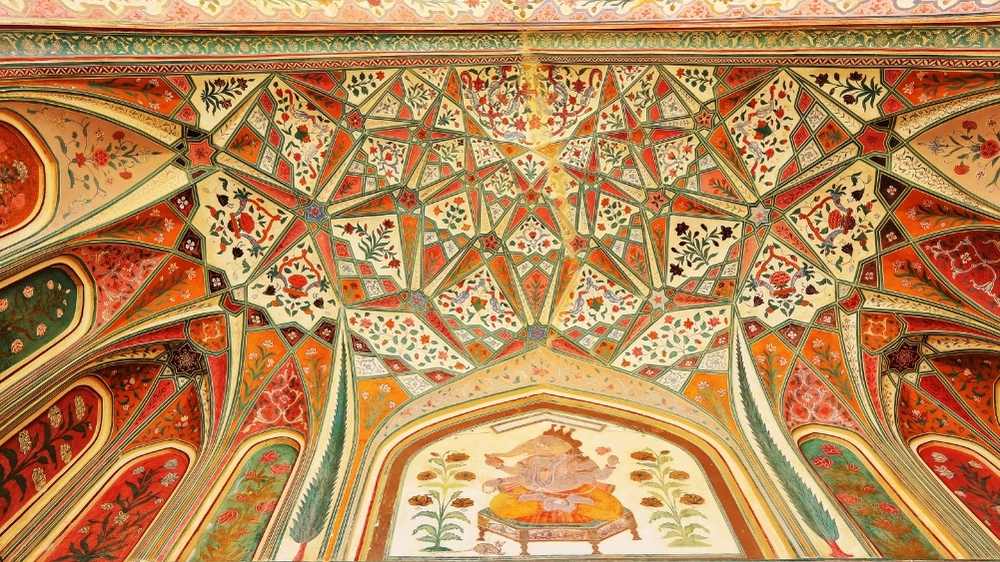
amber palace gate paintings


Located in the state of Rajasthan, between the tropical forests of the east and the Great Indian Desert of the west, Jaipur is a city at a geographical crossroads. It’s a crossroads in another sense, too, a mix of past and present, a vibrant, modern city where history comes alive. Beyond the resorts and popular historic attractions, you can find yourself strolling through a neighborhood of high-rise apartments and office buildings one minute, and the next minute you’re peering through a line of trees at a magnificent sandstone haveli (mansion) built in the Mogul style, combining elements of Islamic and Indian art.


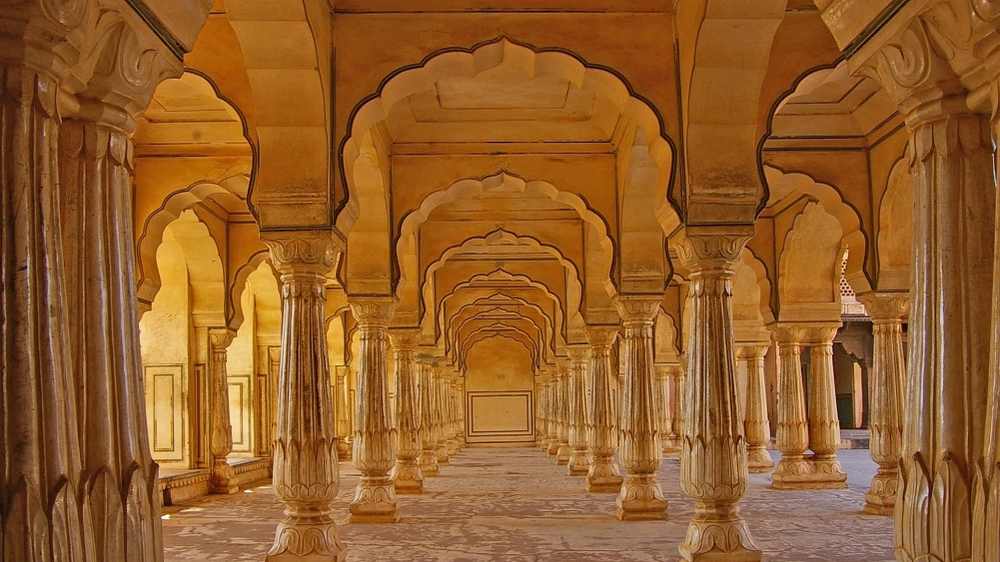
amber palace arches

Timelessness

There’s a sense of timelessness to be found on the city’s narrow streets that lie beyond the wide main thoroughfares. Parts of the city are exactly as they were 100, 200, 300 years ago, with buildings dating back to the city’s founding in the 1700s. These places are the city’s soul, and you can feel its vitality in the old frescoes, in the arcaded walkways, in the street vendors selling everything from food to rugs to gemstones. The city itself is a work of art, but like all great works of art, there is a great deal of thought and planning behind it. Jaipur’s original architects designed the city by combining European urban planning theories with an Indian design philosophy called vāstu śāstra, bringing together the best of what the world has to offer. Whether you’re designing a city or a piece of jewelry, you have to keep your eyes open to different styles and different approaches. It’s how you create something original and timeless.


palace fresco


But it’s not just the buildings that are beautiful. The people of Jaipur embody the timeless sense of the city. You’ll hear many languages spoken, a mix of modern and traditional attire, and many different cultural traditions practiced, but what the people there have in common is a real joie de vivre that some might find lacking in the denizens of larger cities. This warm disposition goes hand-in-hand with living in a beautiful city full of parks, lively bazaars, and historic buildings that carry the rich and creative tradition of the Mughal era into the 21st century.


hawa mahal jaipur

Craftmanship

Everywhere you look you’ll find craftsmanship, whether in the small restaurants serving kachori and lassi or in the towering edifices of Jaipur’s famous palaces. It is clear that the city’s architects valued both the function of a place and its aesthetic. The pink sandstone of the City Palace, Hawa Mahal, or any of the city’s other iconic buildings that give the city its nickname, can appear pastel in the sunlight, bright orange in morning, berry in the shadows of afternoon, and sandy on a cloudy day. Like a well-cut gemstone, different light, different weather, even different seasons give the Pink City a different character. When arrested by the beauty of these places, you begin to understand that the two aren’t separate, form and function, but work together to make a thing what it is. What it does and how it makes you feel can’t be separated. That is the union of art and craft that we try to bring to everything we do.


Mogul, About Us

  • Hits: 1977

A Fresh Look at the Classic Cameo

  • Short Description: Cameo carving is an ancient art form, but modern technology lets us create something new and timeless. It gives us a lot of precision and frees us to create even more imaginative, intricate designs, resulting in something far more ethereal.

When you think of cameos, you might picture antique jewelry from the Victorian era, or something even older, like the famous onyx cameos of ancient Rome. These carvings, often worn as a pendant, ring, or earring, can be carved into a surface, or the surface can be carved around the image, creating a raised relief. It is a style of jewelry that can seems quaint or old-fashioned, like something that belongs in a museum or to be worn only as part of an overall “antique” aesthetic. But the cameo can be so much more.

Ancient Form

It is an ancient art form, but modern technology lets us create something new and timeless. Using state-of-the-art laser carving from Germany, we can etch stunning images using the traditional cameo medium of onyx and shell. The laser gives us a lot of precision and frees us to create even more imaginative, intricate designs. The result is something far more ethereal, whimsical, and stylish than the traditional cameo. And for lovers of modular jewelry, some of our cameos are designed to pair with your favorite chain, so you can swap them out depending on the mood or occasion.


SYNA CAMEO PENDANTS


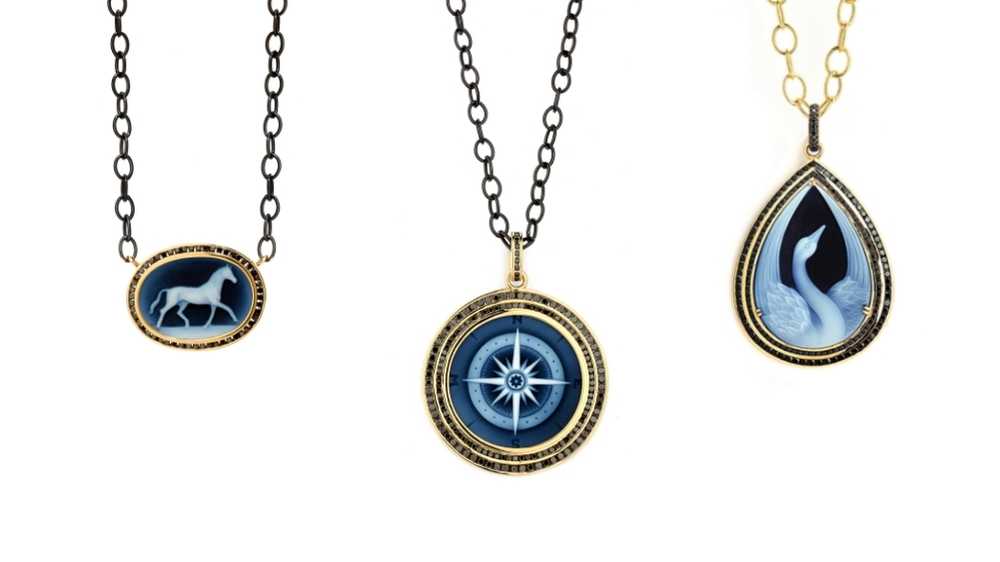
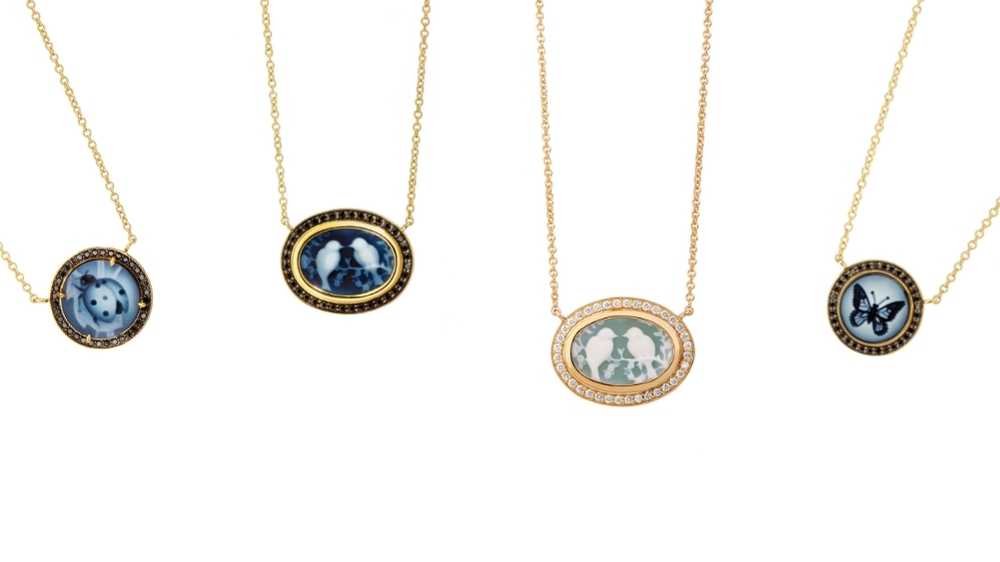
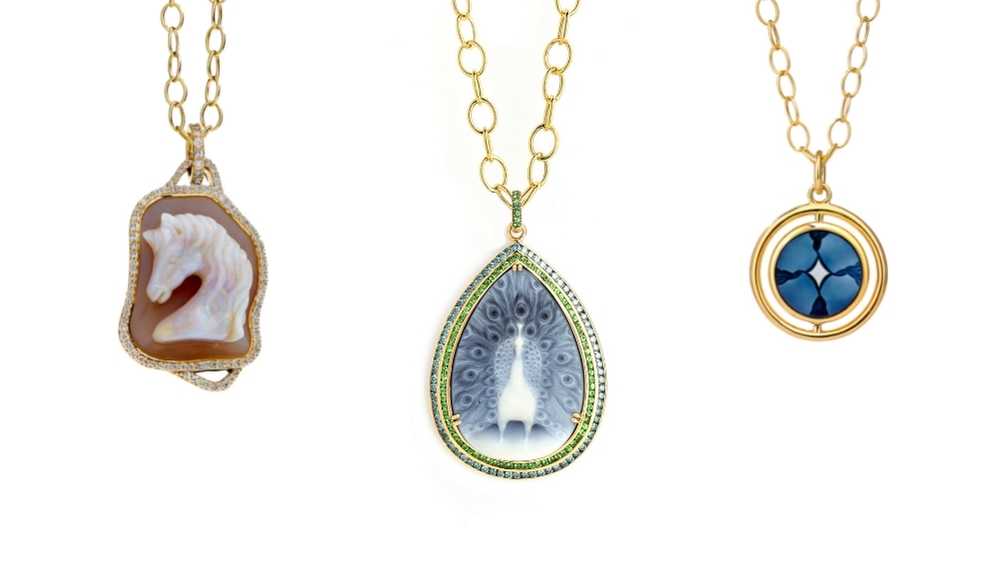
Many classic cameos, whether from Rome, Europe, England, or India, tend to depict famous historical figures in profile. Fans of Syna know we love to depict beautiful scenes from nature. Our cameos capture these scenes in all their gorgeous complexity thanks to our laser etching techniques. Lovebirds on a blooming branch or the details of a butterfly’s wings jump out in an elegant black and blue-gray contrast. And for those with the wanderlust of the swallow, there’s a striking compass pendant in black onyx, 18-karat yellow gold, and black diamonds just for you.


SYNA CAMEO NECKALCES

Modern Sensibility

We try to inject a modern sensibility into even our more traditional cameos, like our Mogul Opal Carved Horse Pendant. The horse and its mane are rendered in great detail in sparkling Australian opal, standing out against an amber opal backing. We love the eye-catching play of color that occurs when light strikes opal. It’s the perfect medium for this kind of piece, striking a balance between classical elegance and a modern, fun vibe. Though it has a few of the familiar elements of the antique cameo, the asymmetrical border of 18k yellow gold and champagne diamonds adds a fresh take to a classic look. Framing the luminescent white horse, it’s a look we know you’ll fall in love with.


SYNA COLORFUL CAMEOS

Gems

  • Hits: 1860