Complimentary Shipping & Fuss-Free Returns

Quiet Luxury: The Understated Statement

  • Short Description: Luxury is no longer about making the most noise with brand names and logos everywhere. It’s not about conveying status or calling attention; it’s about wearing something that is well-made, meaningful, and quietly stylish.
  • Long Description: Luxury is no longer about making the most noise with brand names and logos everywhere. It’s not about conveying status or calling attention; it’s about wearing something that is well-made, meaningful, and quietly stylish.

Music is not just about the notes. Chord progressions, melodies, harmonies, and the way these components interact are part of the experience, but dynamics matter, too: when to play loud, when to play quiet, when to keep it steady, when to surprise the listener and get quiet when they’re expecting loud. And perhaps even more important than the notes you play are the notes you don’t play: the silences between phrases, the gaps that create rhythm.

Meaningful

While playing lots of notes at a high volume makes a lot of noise and gets noticed, the gaps and silences, space and rhythm, make a thoughtful statement. It’s the same in other art forms—the colors you don’t use, the space you don’t fill, the ideas you don’t express, the action you don’t explain is as meaningful as what you actually do paint, or write—and fashion is no different. Luxury is no longer about making the most noise with brand names and logos everywhere. It’s not about conveying status or calling attention; it’s about wearing something that is well-made, meaningful, and quietly stylish.

The distinction underlines the difference between flash and taste, between the latest hype and a carefully considered aesthetic. The person interested in the latter exudes confidence and personality: they are not making purchases based on status but on what they find beautiful and made with craftsmanship and artistry.

More Joy

It is also about making intentional choices. We are all becoming increasingly concerned about the future, about what kind of world we want to create, live in, and leave for future generations. These attitudes filter into our purchasing habits. We want things that are going to put more joy into our lives and into the world. We want things that are going to last a lifetime, not fall apart or fall out of fashion in a year. We’re not buying to show off wealth or show that we’re part of some trend; we want things that are meaningful to us, that connect us with others, things that are handmade and are built to last.

You know how good your clothes and jewelry are, and that makes you feel good about yourself. It doesn’t matter what anyone else thinks, or whether or not they know what brand you’re wearing or how much you paid for it because you’re doing it for yourself. And soon, others will take notice. Not because you’re calling attention to yourself, but because of the aesthetic you’ve put together and the confidence you exude while wearing it. You’re not making a lot of noise; you’re playing the silences, making music in the pauses. That’s the essence of “quiet luxury,” the understated statement.


Reflections, Jardin, About Us

  • Hits: 1963

Turquoise: The Desert Sky in December

  • Short Description: The beautiful blue-green color of Turquoise, the birthstone of December, will transport you somewhere warm in the depths of winter: to tropical seas with its blue-green color and oceanic patterns, or to the clear desert sky above the American Southwest or Persia in its sky-blue variety.
  • Long Description: The beautiful blue-green color of Turquoise, the birthstone of December, will transport you somewhere warm in the depths of winter: to tropical seas with its blue-green color and oceanic patterns, or to the clear desert sky above the American Southwest or Persia in its sky-blue variety.

The beautiful blue-green color of Turquoise, the birthstone of December, will transport you somewhere warm in the depths of winter: to tropical seas with its blue-green color and oceanic patterns, or to the clear desert sky above the American Southwest or Persia in its sky-blue variety. The name by which we know it today comes from the French, who called it pierre turquoise, as the first turquoise to reach Europe passed through Turkey, but its influence and historical and cultural significance range far wider than that.

History

While the Persians (located in modern-day Iran) have been mining turquoise for two thousand years, the gemstone has been in use for even longer. Turquoise has appeared in jewelry for longer than almost any other gemstone. The subtle bands of light blue that so beautifully complement the dark blue lapis lazuli and contrast the gold in Tutankhamun’s mask, dating back to the 1300s BCE, are turquoise. It was one of the first stones mined by humans, as it can be collected from the ground without a lot of manpower, sophisticated tools, or complex mining techniques. Even today, it is often mined by hand, just as it was thousands of years ago.

During the Mogul era, master artisans from all over Asia flocked to India. Persian artists brought their love of turquoise, integrating that unique shade of blue-green into the classic Mughal color palette of gold, jade, ruby, and sapphire. It’s one of the inspirations for some of our own pieces, such as the Seven Chakra Charm Bracelet and Mogul Kamala Turquoise Earrings.

In the United States, however, turquoise is most closely linked to Southwestern Native American cultures, such as the Pueblo, Zuni, Hopi, and Navajo. Turquoise is connected with elemental forces in many Southwestern creation myths. The Navajo say the first man and woman used a stone disk with a turquoise edge to create the sun, while for the Zuni, blue turquoise represents masculine energy and the sky and green turquoise represents feminine energy and the earth.

Color

If you remember your high school chemistry class, you might remember the time the teacher added copper to a flame and turned it green. Copper has the same effect on turquoise. Its presence in trace amounts gives the stone its distinctive color, ranging from blue-green to pale green.

In addition to copper, turquoise also contains iron. Both copper and iron are prone to oxidation: it’s why metal objects form rust and the copper Statue of Liberty has turned green. Over the course of decades, your turquoise may slowly change color due to oxidation, with complex patterns of green, brown, and yellow forming on the surface. This is a natural phenomenon that many turquoise lovers find beautiful.

Cleaning and Care

Turquoise was born in the desert and prefers that kind of arid climate, but it can thrive anywhere with a little care. Due to its porous surface and the presence of copper and iron, exposure to oils (including skin oils), humidity, and moisture can accelerate this color change or damage the stone. When you’re not wearing it (which might not be often, because you’ll never want to take it off!), store turquoise jewelry in a dry and dark place, preferably in a sealable plastic bag inside of a box. Take care to wipe down your turquoise with warm soapy water after use.

Gems, Jewelry Care

  • Hits: 2362

Topaz, A Talisman of Wisdom, Beauty and Longevity

  • Short Description: A talisman of wisdom, beauty and longevity, many people in India have believed that Topaz worn above the heart assures long life, beauty and intelligence.

Topaz served as a symbol of strength among the Greeks. Europeans at the time of the Renaissance believed in its power to destroy curses and dispel anger. "Topaz" comes from the Sanskrit word "tapas" which means "fire". For centuries, many people in India have believed that topaz worn above the heart assures long life, beauty, and intelligence. In the past, a lot of people mistook any yellow-colored gemstones for topaz. "Imperial Topaz" named in honor of the Russian monarchy, is the distinct pinkish-orange hue discovered in the 19th century near the Ural Mountains in Russia. 

COLOR

This gemstone features a variety of colors, from colorless, light blue, yellow, orange, pink, violet, brown, and very rarely, red. The element of chromium causes natural pink, red, and violet to purple colors in topaz. Imperfections at the atomic level in the topaz crystal structure can cause yellow, brown, and blue color. Colorless topaz is plentiful and often treated to gove it a blue color. The rarest, and hence most prized color, is a vivid purplish pink. 

CLARITY

Faceted blue topaz is almost always free of eye-visible inclusions. Other more rare colors like orange and pink may show inclusions more often and still be valuable due to the color's rarity.

SOURCES

The largest topaz mines are in Brazil, Pakistan, Russia, and Sri Lanka.

Treatments

The vast majority of blue topaz seen today is the permanent result of changing the color by irradiation and heating. "Mystic Topaz" has an extraordinary rainbow effect and is made by coating colorless topaz with a thin artificial film placed on the surface by vapor deposition.

care

It is important to avoid steam or ultrasonic cleaners for topaz. Warm, soapy water works best. 

Gems

  • Hits: 1921

A Soft Guide to Gemstone Hardness

  • Short Description: Hardness is defined as the ability of a gemstone to resist scratching and abrasion. Tenacity measures a material's resistance to blows. It is important to check both aspects when jewelry wearability is concerned.

Diamond is the hardest natural material in the world. However, it is also brittle. Scientifically speaking, hardness measures the ability to resist scratching, nothing more. A gemstone’s overall wearability grade takes hardness into account. However, it’s only one of several factors to consider.

What Does Gemstone Hardness Mean?

Gemstone hardness is a very misunderstood property. The word “hardness” has a very specific scientific meaning in gemology that differs considerably from its everyday usage. The scientific definition of hardness is the ability to resist scratching, nothing more. If you ask most folks, they’ll say feathers are soft and glass is hard. In the world of gemology, however, glass is fairly soft. A variety of what gemologists consider hard substances could easily scratch it.

Hardness depends on the bonds that hold the atoms together within a crystal structure. This bonding is evident in the ease with which the layers of atoms at a surface can be separated by applying pressure to a sample of another material. If the second material is harder than the first, it’ll leave a furrow or scratch. That represents the breaking of millions of atomic bonds on a microscopic scale. The hardness of a mineral is, specifically, its “scratchability.” Every mineral can be ranked based on those other minerals it can scratch.

The Mohs Scale of Hardness

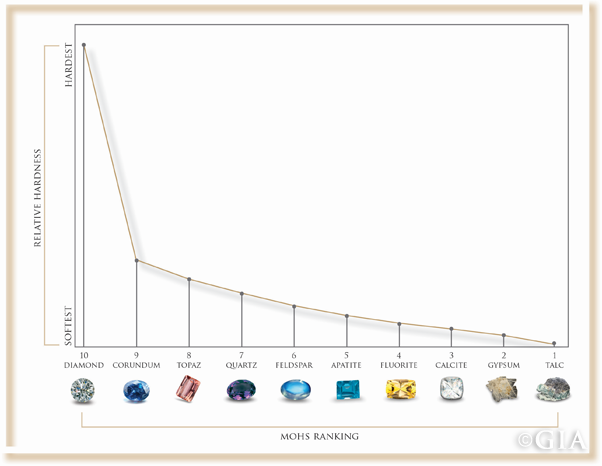
In 1812, the mineralogist Friedrich Mohs (1773-1839) established a reference scale of ten common minerals, ranked in order of increasing hardness. This scale, shown below, is called the Mohs scale of hardness.


10 Diamond
9 Corundum (rubies and sapphires)
8 Topaz
7 Quartz (Example: It scratches window glass)
6 Feldspar (Example: A steel file will scratch it)
5 Apatite
4 Fluorite (Example: A knife will scratch it)
3 Calcite (Example: A copper coin will scratch it)
2 Gypsum
1 Talc (Example: A fingernail will scratch it)


Each of these minerals can be scratched by the one above it and will scratch the ones below it. Minerals of the same hardness will not scratch each other. Thus, a ruby cannot scratch a sapphire and vice versa. A diamond is much harder than a corundum, even though they are only one division apart on the scale. 


The Mohs scale starts approximately linear, but the curve climbs sharply at the high end. Corundum (9) is twice as hard as topaz (8), and diamond (10) is four times as hard as corundum. (Note: diamonds, and only diamonds, can scratch other diamonds). 

Hardness Ranges

The hardness of a material may vary slightly with composition and also with its state of aggregation. Measuring gemstone hardness can be tricky. Often, a mark that looks like a scratch is actually a trail of powder left by the supposedly harder material. Fractional hardness scores, like 5.5, are reported when the literature has indicated an intermediate value. However, it is really not critical whether the hardness of a mineral is 5 or 5.5. A hardness range is much more meaningful.

Tenacity

Going back to the old saying, a diamond is both hard, defined scientifically, and brittle. The steel of a hammer (hardness 5 or 6) won’t scratch a diamond, but it can shatter a diamond.

Tenacity measures a material’s resistance to blows. For gemstones, these measurements are usually given as descriptive terms. As it so happens, most gemstones would be considered brittle. There are a few exceptions. Cryptocrystalline quartz, such as chalcedony, has “tough” tenacity. Jade, both jadeite and nephrite, has “very tough” tenacity.


There are a lot of misconceptions about how MOHs hardness relates to a  gemstone's toughness. This is GIA's MOHs hardness and gemstone toughness  chart. Think of MOHs hardness as a gemstone's ability


Gemstone Wearability

Assuming you don’t regularly bash your jewelry with a hammer, scratching is a hazard encountered more frequently. Think of how many times every day you put your hands inside pockets, purses, glove compartments, and desk drawers. Now think of what brushes against a ring when you do those things.

Gemstone hardness contributes greatly to the degree to which a gem will show wear. This is often referred to as wearability or sometimes “durability.” Opal with a hardness of 6 will be rapidly covered with fine scratches and lose its polish if worn every day as a ring stone. The scratches may be tiny, even microscopic, but they’ll accumulate and become visible over time. On the other hand, ruby with a hardness of 9 will remain bright and lustrous for years because it’s harder than most of the abrasive particles that contribute to wear.

Gems

  • Hits: 7074

Opalicious October

  • Short Description: Writers have compared opal's color to volcanoes, galaxies and fireworks. Many cultures have credited opal with supernatural origins and powers. The Romans gave it a name - opalus - that was synonymous with "precious stone"

According to Arabic legend, opal was believed to contain lightning. Writers have compared opal's color to volcanoes, galaxies, and fireworks. Admirers gave extraordinary opals poetic names like Pandora. Light of the World and Empress. In ancient Rome, this gem symbolized love and hope. The Romans gave it a name - opalus- that was synonymous with "precious stone". Many cultures have credited opal with supernatural origins and powers. The ancient Greeks believed opals gave their owners the gift of prophecy and guarded them from disease. Europeans have long considered the gem a symbol of hope, purity, and truth. 

PLAY OF COLOR

Opals display a phenomenon known as play-of-color. When a stone has play-of-color, it is referred to as precious opal. The main categories of precious opal are white, black, boulder, and crystal or water. Fire Opal, also known as Mexican Opal, sometimes doesn't show play-of-color. 

CLARITY

With an opal, clarity is its degree of transparency and freedom from inclusions. An opal's clarity can range all the way from completely transparent to opaque. A cloudy or milky background color can sometimes signal a lack of stability. Opals can have fractures and surface blemishes. Matrix, or host rock, along with signs of crazing, a fine network of cracks, have an impact on opal's durability and value.

SOURCES

Fine opal comes from all over the world. The most significant sources are Australia, Mexico, and Ethiopia

TREATMENTS

Opals can be treated by impregnation with oil, wax, or plastic. Opal doublets or triplets are thin slices of opal glued to a base material and covered with a thin dome of clear quartz. These gems are more resistant to scratching but are considered less valuable. Some opal can be dyed. 

CARE & CLEANING

The only safe way to clean opal is with warm, soapy water. Opals are sensitive to heat or excessive dryness which can lead to crazing or internal cracks.  


Gems

  • Hits: 2070